You did it!
Packed up your life, moved abroad like you always said you would, excited to embrace a new city and its people.
Unfortunately, it seems that that feeling is not exactly mutual.

Moving abroad is huge, but making friends as an expat once you finally make it over there? Well, that feels like an even bigger hurdle.
London is an odd mix of overly polite and subtly stand-offish.
In New York, people barely slow down long enough to look you in the eye.
As for Paris, well, the closest thing you’re getting to intimacy is a raised eyebrow at your pronunciation of croissant (it’s “qwasson”, right?).
While every major city has its own brand of “difficult”, the expat loneliness is a pretty universal experience…and very, very real.
That’s why it’s so easy to fall into the “expat bubble”. And honestly, why would you not want to be surrounded by people who understand the intricacies of starting over in a new city?
The thing is, while there’s nothing wrong with having a supportive community of expat friends, it can become a comfort blanket that stops you from fully embracing your new life and everything it has to offer…yes, the good, the bad, AND the ugly.
That's where this guide comes in, to help you break into the local social scene of your new city with confidence. And to help you build the kind of connections that help you feel seen, heard, and at home, even when you're not.
Why making friends abroad is genuinely harder
Once you’ve unpacked your bags (mostly), picked up a decent couch on marketplace, and found your regular grocery store, the excitement starts to wear off and the not-so-exciting reality sets in: you can be surrounded by millions of people, in one of the world’s most exciting cities, and still feel completely invisible.
Making friends as an adult is already hard enough back home, where you at least have history, language, cultural shorthand, and the remnants of your old social life working in your favor. Strip all of that away, and you're essentially starting from zero in a place where the social rules feel as foreign as the language, the in-jokes don't land, and everyone already seems to have their people.
Research backs up just how hard this can be — it takes around 50 hours together just to move from acquaintance to casual friend, then 90 hours to feel like real friends, and 200+ hours to build the kind of closeness where you almost feel like family. That's a lot of time to accumulate when you're new somewhere and have no existing social infrastructure to work with.
Add a language barrier, a different cultural approach to friendship, and the very real exhaustion of settling into a new life, and it's no wonder so many expats retreat into… the bubble.
The expat bubble: comfort zone or cosy trap?
Other expats are often the first people who truly get how it feels to start over somewhere new. They understand the visa stress, the bureaucratic headaches, the homesickness triggered by the smell of a simple dish, floating in from a random restaurant.
There's an immediate shorthand there that can feel like friendship before it technically is.
The thing is, though, when your entire social life hinges on a community of people who are also just passing through — or at least treating the city as temporary — it's harder to build the kind of roots that make a place feel like home. The connections tend to stay surface-level, because everyone is slightly bracing for the next departure.
That's not a reason to avoid expat communities entirely. They can be genuinely supportive, and some of the best friendships do start there. But they work best as a starting point, not a permanent address.
The goal is to build a social life that's mixed — part expat, part local, part whoever-you-met-at-that-Wednesday-night-thing. That's when a city starts to feel less like somewhere you're staying for a bit, and more like somewhere you actually live.
The truth about making friends with locals
Making local friends as an expat is one of the most rewarding things you can do in a new country. It's also, if we're being honest over here, one of the harder ones.
Every culture has a different relationship with friendship. Coming to terms with that, rather than fighting against it, makes the world of difference.
Let’s explore.
London: Brits are warm, witty, and excellent at small talk. They are also famously slow to actually invite you anywhere. If someone from London says "we should do this again sometime," they probably mean it — they'll just need at least three more encounters and a group chat before it materializes. Don't mistake the reserve for rejection. Keep showing up.
→How to make friends in London, a guide (2026)
New York: New Yorkers are some of the most interesting, direct, and secretly generous people you'll ever meet, but they are absolutely always busy. The city moves fast and the calendar fills up faster. "Let's get dinner" without a specific date means nothing here. Be the one who sends the follow-up, names the place, and locks in the time. New Yorkers respect that kind of efficiency.
→How to make friends in NYC, a guide (2026)
Paris: Parisians get a bad rep for being cold, which really just means they take friendship seriously. Casual acquaintances and real friends exist in two very distinct categories, and getting from one to the other takes time. But once you're in, you're really in. The key is patience, consistency, and ideally, an attempt at French, however imperfect. (Yes, even the croissant thing.)
Mexico City: Chilangos are warm, generous, and social. CDMX has a strong culture of gathering, where meals go long, people add you to plans last-minute, and showing up to something is considered a gesture of goodwill in itself. Being open and present goes a long way here.
Taipei: Taiwanese friendliness is sincere and low-pressure. Friendships often build slowly through repeated, low-key interactions, whether that’s a shared commute, a regular coffee spot, or a group activity. Patience and consistency are more effective than grand gestures.
The common thread across all of these? You can't read local friendship norms through your home-country lens. What looks like coldness might be respect for personal space. What looks like over-friendliness might be a cultural warmth that runs deep. Curiosity beats assumption, every time.

The truth about making friends with locals
There's no universal formula, but there are conditions that consistently help friendships form, regardless of which city you're in.
Here's what works.
1. Build a routine, then protect it
The single most effective thing you can do when you move abroad is find one or two regular activities and show up to them consistently…for a good couple of weeks.
The magic of a routine isn't the activity itself, but rather the repeated exposure to the same people in a low-pressure setting. The running club you join. The language class you take. The coffee shop you start treating as your desk on Thursday mornings. Over time, familiar faces become conversations, and conversations become something more.
The goal isn't to be impressive on day one. It's to still be there on day 30.
2. Do things that create a reason to talk
There's a reason bars and clubs are actually among the worst places to make new friends. The music is loud, everyone is already in their group, and there's no natural reason to speak to the random person next to you at the bar.
Shared activities solve this. A pottery class, a hiking club, a group dinner — these all give you something to talk about that isn't "so, what do you do?" You have instant common ground, which takes the pressure off and lets the actual connection happen more naturally.
3. Learn a little of the language — even badly
When it comes to learning the local language, trying is everything.
Making an effort signals something that transcends the actual words: that you're here to engage, not just pass through. It shows respect for where you are, and it opens doors that stay shut when you stay entirely in English. A broken "merci" in Paris, a fumbled "dòuibuqǐ" in Taipei, a slightly-too-formal "gracias" in CDMX — it all counts.
Language learning apps and local classes also happen to be excellent places to meet people who are as curious about the world as you are.
4. Try structured social experiences
One of the fastest ways to meet people in a new city (locals and expats alike) is through structured social formats that are specifically designed with meeting people in mind.
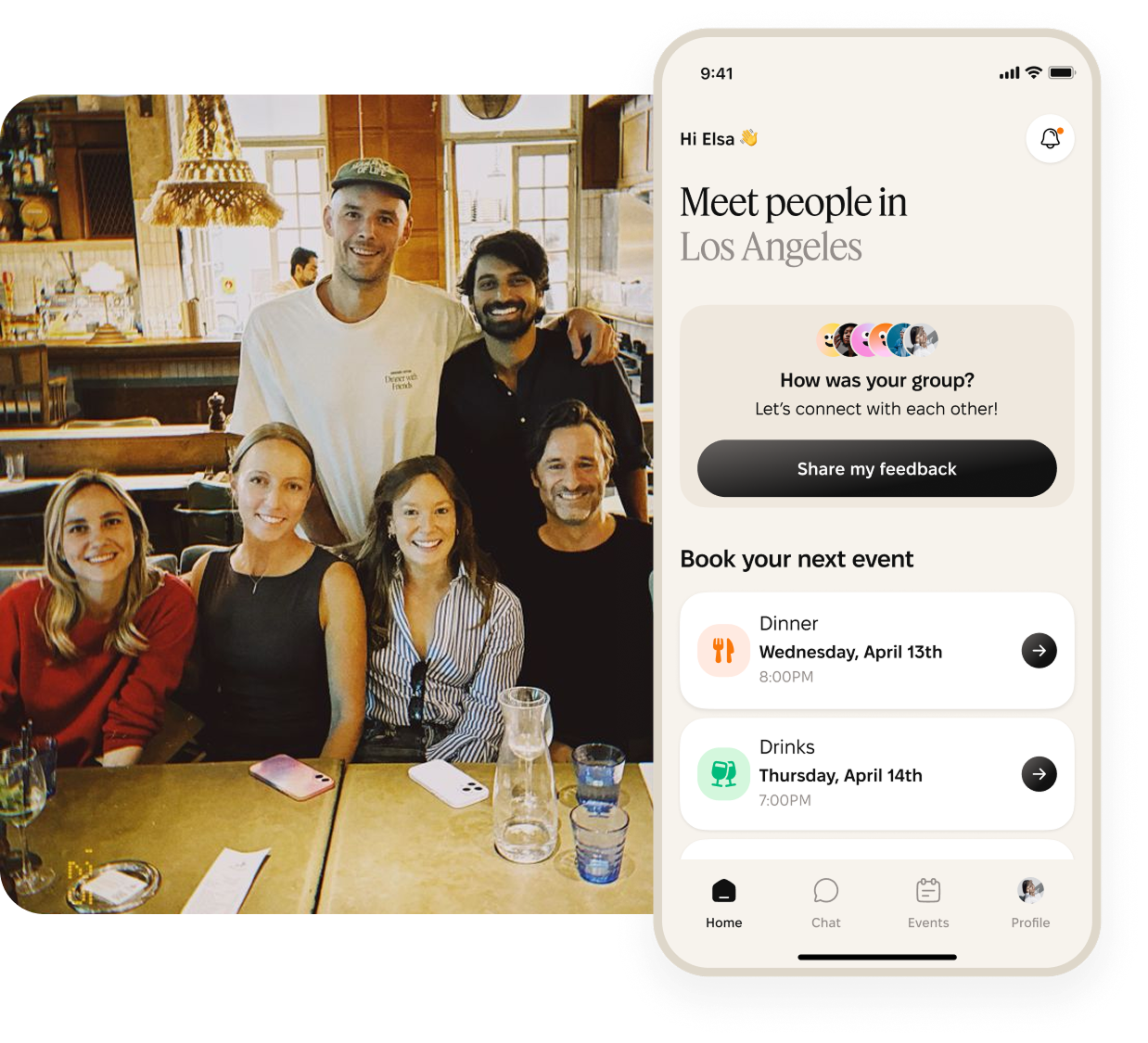
Timeleft hosts weekly dinners, drinks, coffees, and runs in 200+ cities worldwide, bringing together small groups of people for in-person experiences with no bios, swiping, or planning required. It's designed to remove the awkward "I don't know how to start" bit and just put you at a table with interesting people. All you have to do is show up.
It's available in New York, London, Paris, Mexico City, Taipei, and hundreds of other cities, which means, whether you're settling in or still finding your feet, there's likely a table with your name on it this week.

5. Follow up (and be specific)
This is the step most people skip, and it's the one that turns a nice evening into an actual friendship.
After meeting someone you click with, follow up within 24–48 hours. Not with "great meeting you" and nothing else, but rather with a specific suggestion. "Are you free for coffee on Saturday?" is a plan. "We should hang out sometime" is not.
In most cities, the person who follows up first is the person who makes the friendship happen. Be that person.
6. Give it time
And more of it than you think!
Moving abroad tends to come with an unspoken pressure to have it all figured out, and fast. New friends, a social life, a sense of belonging, ideally before you've even fully unpacked.
But friendships take time to build, especially across the divide of culture and language. It generally takes a minimum of 50 hours of shared time to move from acquaintance to casual friend, which translates to weeks and months of showing up, following up, and being present.
What to do when language is a real barrier
Not every expat move comes with a shared language, and that adds a genuine layer of difficulty to making friends. A few things that help:
- Language exchange meetups pair you with someone who wants to practice your language while you practice theirs. It's reciprocal, structured, and a low-pressure way to spend time with a local. Apps like Tandem and Meetup list exchanges in most major cities.
- Bilingual social events and international community groups are increasingly common in cities with large expat populations. They're designed for exactly this kind of in-between.
- Activity-based socializing matters even more when language is a barrier. Running together, cooking together, taking a class together, all reduce the reliance on fluent conversation and let connection happen through doing.
How to turn a one-off meeting into a real friendship
You can go to all the right events and still end up with nothing to show for it if you're not being super intentional about the second hangout.
Loved chatting to that one Parisian at dinner, the one with the great shoes? Message them within 48 hours. Suggest something specific — a place, a date, a plan. And if you're using Timeleft, the Repeat feature lets you invite someone you connected with to your next experience, which makes the follow-up even easier than a text.
After that, keep showing up in their world in small ways. Respond to a story, share something relevant, suggest a plan when you think of one. The small, consistent gestures are what build the thing over time.
A word on patience (and the messy middle)
Social connections abroad take longer to form than in your home country, because you're building them without the shortcuts. Give yourself at least three months before drawing any conclusions. And in the meantime, keep going to the things, and doing the work.

FAQs (we know, the struggle of making friends as an expat is real)
How long does it take to make friends abroad?
Longer than most people expect, and that's totally normal. Research by Hall (2018) found it takes around 50 hours of shared time to move from acquaintance to casual friend, and up to 200 hours to build a close friendship. When you factor in cultural differences, language barriers, and the general uncertainty of settling into a new place, the timeline can stretch further. Give yourself at least three months of consistent social effort before drawing any conclusions.
How do I make friends in a country where I don't speak the language?
Start with activity-based socializing, where connection happens through doing rather than talking. Running clubs, cooking classes, and group experiences like Timeleft all reduce the pressure on fluent conversation and let rapport build naturally. Language exchange meetups are also worth trying since they pair you with a local who wants to practice your language while you practice theirs. Even a small effort with the local language goes a long way.
Is it normal to feel lonely as an expat?
Very. Expat loneliness is one of the most common and least talked-about parts of moving abroad. According to the U.S. Surgeon General's Advisory on Loneliness, loneliness has reached epidemic levels globally — and expats face a specific version of it, having left behind their existing social infrastructure without yet building a new one. If you're feeling it, you're not failing at expat life. You're just at the hardest part of it. It gets better with time, routine, and the right environment.
Where do expats actually meet locals?
The honest answer: not at bars, and rarely by accident. The most effective places are ones built around a shared activity or recurring commitment. Think running clubs, language classes, community sports leagues, volunteer groups, and structured social experiences like Timeleft. These formats create repeated contact with the same people over time, which is the actual ingredient friendships are built from. One-off events can spark something, but it's the places you keep coming back to that turn a familiar face into a real friend.
Ready to try Timeleft in your city?
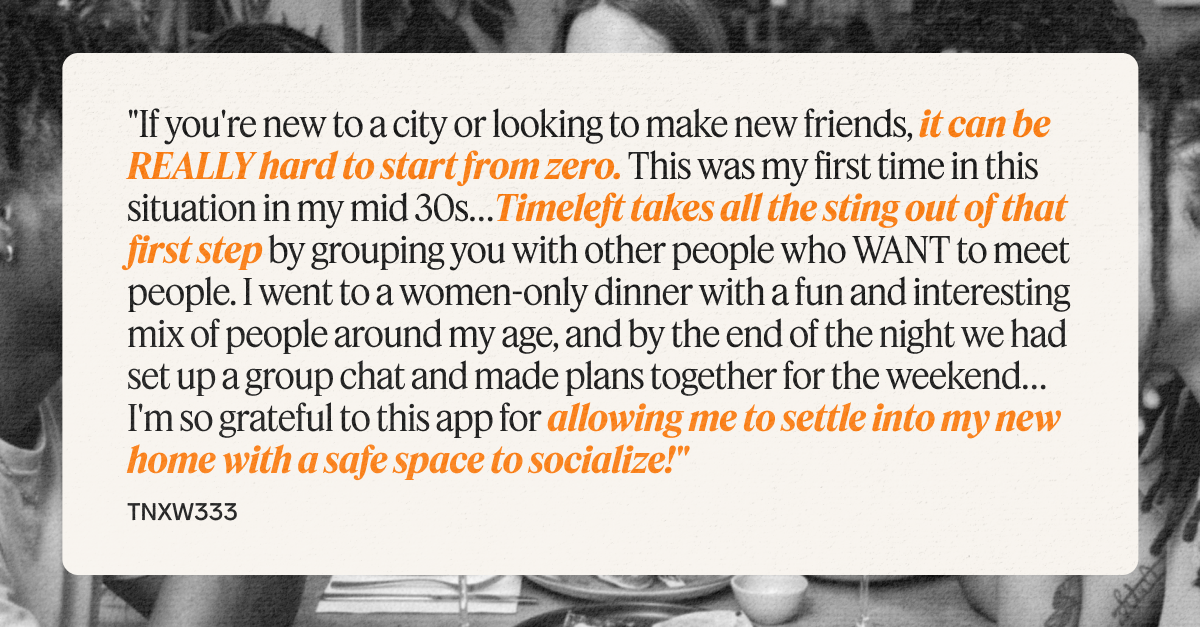
Making friends abroad is one of the harder things about expat life, but also totally worth the effort. The friends you make in a place you chose to be in, from scratch, with people from completely different backgrounds? They tend to stick around.
But it all starts with showing up, which you can do this week already.
Timeleft hosts weekly dinners, drinks, coffees, and runs in New York, London, Paris, Mexico City, Taipei, and 200+ other cities. No planning, profiles, or awkward first messages. Just a place to meet up, five other interesting people, and whatever happens next.